


MimiWave®

Contactless Infant Breathing Monitor
Contact usNext-Generation Radar Solutions
We develop radar-based technologies that enable privacy-preserving monitoring. Our systems can detect human presence and position, recognize falls, and monitor vital signs, all without any physical contact with the person being observed or image camera systems. Our sensors and systems are designed for use in healthcare, elderly care, security applications, and smart home environments.
We have a long-term partnership with ADASTRA Lab, with whom we co-develop monitoring solutions for the retail sector, focusing on people movement analytics and store operation optimization.

MimiWave®
Contactless Infant Breathing Monitor
Sudden Infant Death Syndrome (SIDS) claims the lives of dozens of infants in the Czech Republic every year — approximately 1 in 1,000–2,000 newborns.
The fear of unexpected breathing failure leads almost every parent to purchase contact-based monitoring pads, which, however, suffer from major drawbacks:
- they are sensitive to surrounding motion or vibration, which can cause them to miss actual breathing arrests,
- they function only reactively, detecting apnea after it occurs rather than providing early warning signals,
- frequent false alarms increase parental stress and may lead to ignoring real emergencies.
Our Solution
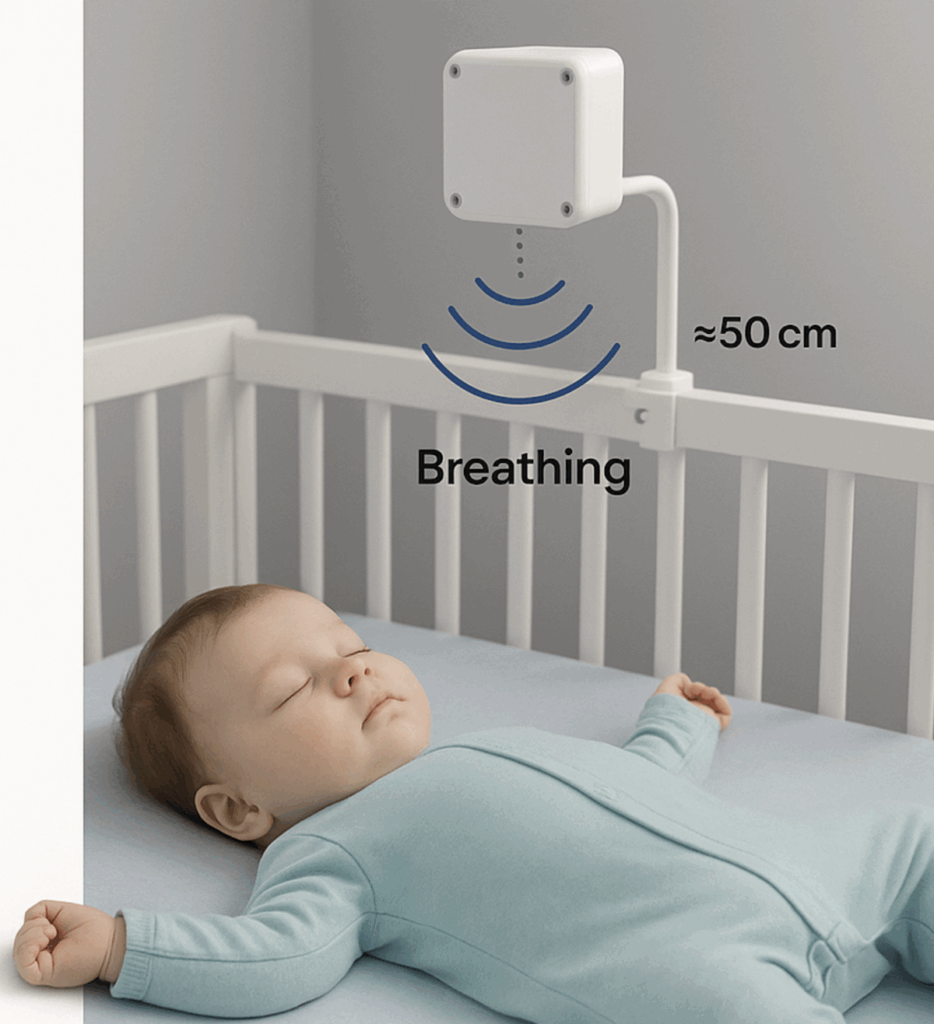
We have developed a non-invasive radar sensor that tracks micromovements of an infant’s chest completely without contact. This allows for accurate and peaceful monitoring without the need for pads or cables.
Key Benefits
Undisturbed sleep – no cables, no mattress pad
Early warning – detects subtle anomalies in breathing rhythm, not just complete apnea
High reliability – radar “sees” through clothing and bedding, significantly reducing false alarms
An energy-efficient, safe technology that can make a difference in seconds and save a life.
Preclinical Testing
The accuracy and functionality of the MimiWave® system were verified through preclinical testing using the advanced SimNewB simulator — a benchmark training system for neonatal care at the Institute for the Care of Mother and Child (ÚPMD). The simulator enables modeling of various breathing patterns — including apnea, obstruction, resuscitation, and normal breathing. The deviation between actual and measured values during normal breathing was found to be less than 3%.